Wearing the Fool’s Hat: Equality with Equity
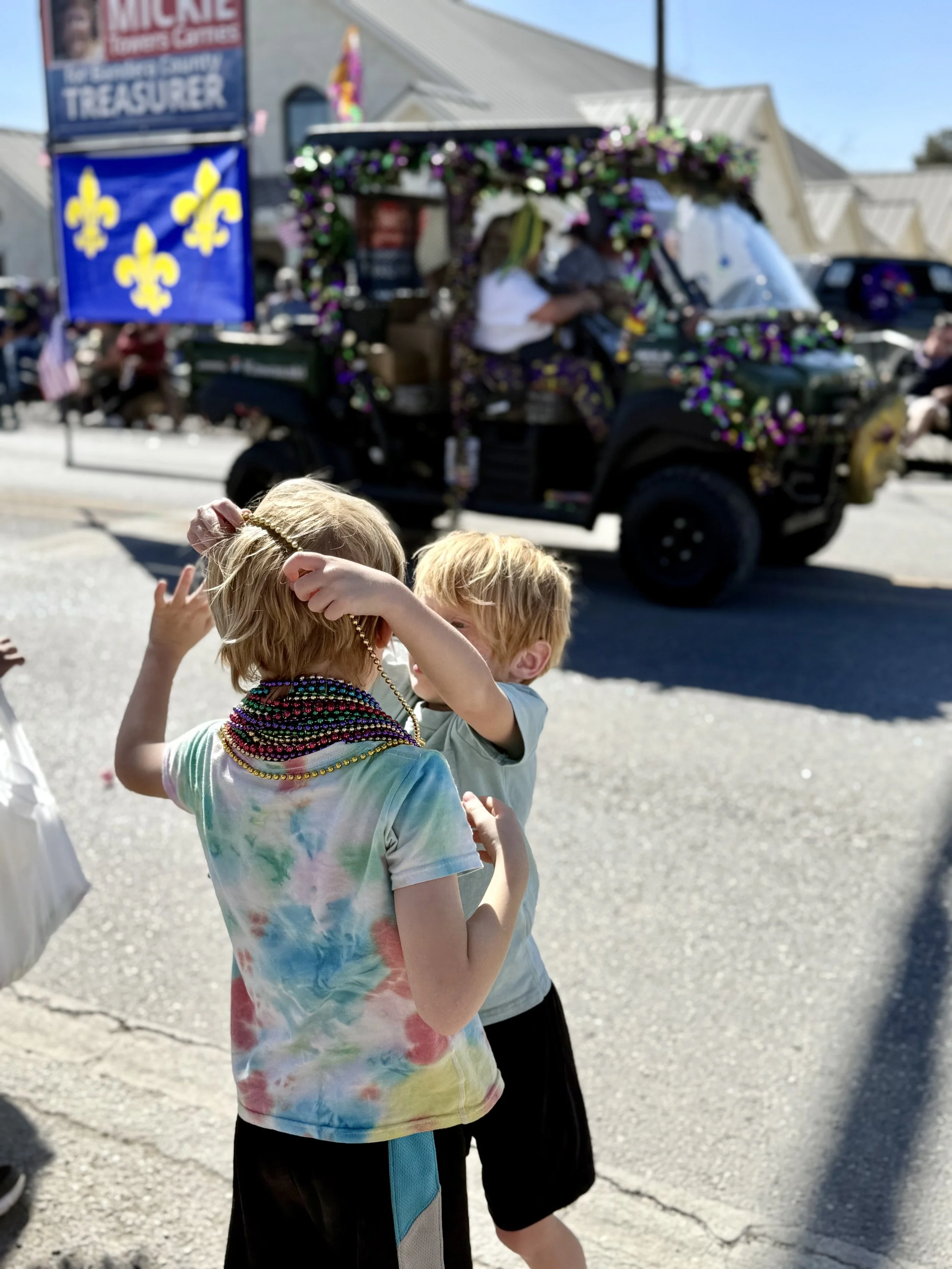
Photo of my two boys celebrating at Mardi Gras parade
I felt especially drawn to the colorful outfits and masks at the Mardi Gras parade I attended with my kids this weekend. There was one person wearing a more traditional mask that looked like a caricature of someone with a silly expression and an elongated nose. This one in particular tugged for more of my attention than the rest. Because of the costume, I couldn't tell anything about the wearer. I couldn’t see if they were a man or woman, child or adult. I simply saw the exaggerated face floating in a sea of people.
Wearing masks during Mardi Gras or Carnival originated in medieval Venice. This tradition allowed for those of different classes, races, or sex to interact in ways that wouldn’t typically be considered acceptable according to social or political norms. Poor mingled with rich. Peasants with Lords. This was political reprieve, allowing the lower classes a moment to feel (even if by mockery and foolishness) equal.
The masks I felt so drawn to today are said to symbolize social equality, and freedom through anonymity because of how they allowed individuals to break past social, religious, and political barriers. The mask allowed christians a time to let loose before Lent, a season of solemnity. As Barbara Ehrenreich suggests in her book Dancing In The Streets, the dancing that emerged in the streets of Carnival were spiritual expression pouring over from the walls of the church as dancing was not prohibited within them. These masks were not only political reprieve, but also spiritual.
The pattern rising to the surface for me as I consider what exactly is breaking through past barriers via Carnival is a pattern of foolishness and mockery. Or, if you will, a pattern of self-expression, of play. I find it exuberating that it was from a place of play that individuals found common ground. For one week, one moment, one short season, through play and silliness, lords and peasants found a form of equality amongst themselves. Peasants dressed like kings. Lords laughed and allowed what would not generally be prohibited. Priests glanced away from debauchery. My mind compares the peasants to children and the lords to parents. An authoritarian system is an authoritarian system whether it be a government or a family. The movie “Yes Day” seems equivalent for children as Mardi gras was for peasants and religious followers. One whole day where the adults must say “yes” to the requests of their children. As my therapist often reminds me, children rarely get the opportunity to make their own choices.
“For one week, one moment, one short season, through play and silliness, lords and peasants found a form of equality amongst themselves. Peasants dressed like kings. Lords laughed and allowed what would not generally be prohibited. ”
Perhaps, the world will always wrestle with the freedom and restrictions that our differences bring. But perhaps, there will also always be moments in time that allow us the freedom to forget about our differences and lay down our societal masks by picking up the mask of play and light-heartedness. As parents, we have the opportunity to offer that reprieve to our children at any time. Through lightheartedness, we may find remembrance that we are both humans, parent and child, deserving compassion and respect as much as the other. Through the mask of foolishness, may we laugh as our child acts as if they are a tiny adult, and realize that that's exactly what they are. They are no less deserving of respect than we because of their developmental differences. If it takes wearing a fool’s hat to see that we are equals with equity, let the fun begin.
Sources:
Hillyer, V.M. A Child’s History of The World.The Century Co., 1924
Pedroza, Katlyn. Mardi Gras: Inspiration to Remove the Masks We Wear. International Mission Board, 2018. https://www.imb.org/2018/02/12/mardi-gras-inspiration-masks/#:~:text=European%20spiritual%20masks%20are%20worn%20during%20Carnival%2C,masks%20to%20protect%20themselves%20and%20their%20reputations. Accessed 8th of February 2026.
Barbara Ehrenreich. Dancing in the Streets: A History of Collective Joy. HB Fenn and Company, 2007.https://www.medievalists.net/2015/02/reverent-irreverence-mardi-gras/
Reid, Anna. Quest Counseling and Wellness. https://questcounselingandwellnesspllc.com/
