
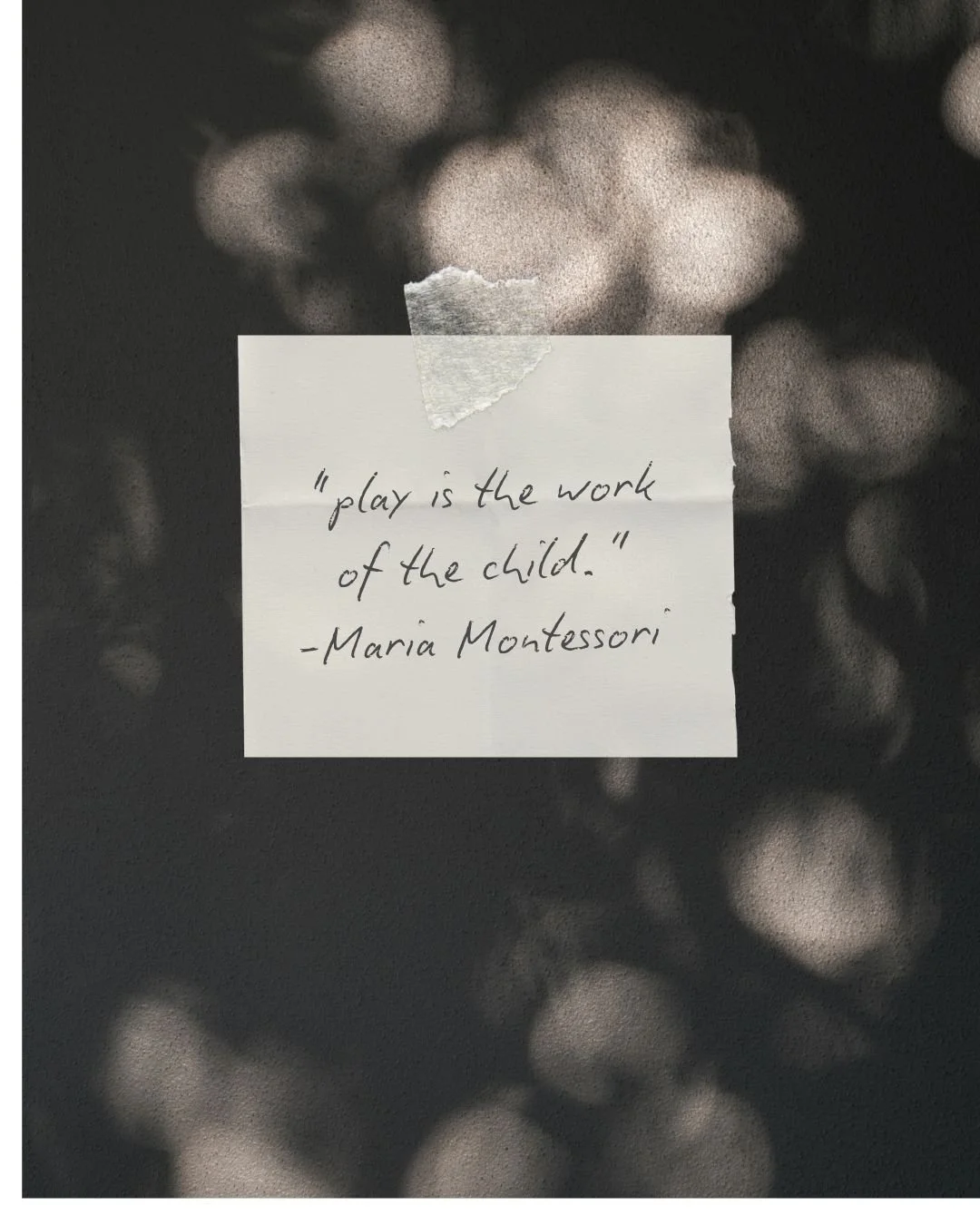
I want to explain the philosophy and developmental science behind this often-quoted phrase by Maria Montessori: “The work of the child is play.” There are thousands of parents and educators on social media who hang this quote in their learning spaces, but how many know the deeper meaning behind it? Based on what I have understood from Montessori's philosophies and today’s brain science, I believe I can reframe this quote as: the work of the child’s brain is to form itself. It creates itself through play.
Montessori referred to the first phase of development (ages 0-6) as the Period of Creation. She didn’t name this period after the child’s style of play, but because, through play, the child creates their brain. Montessori called this the Absorbent Mind inferring that as a child in this phase plays and explores the world, they are unconsciously absorbing everything they touch, see, and hear. This absorbing physically forms their brain. She says ever so poetically, “The impressions not only penetrate the mind of the child but form it. They become incarnate. The child makes it’s own ‘mental flesh’ by using the things that are in his environment.”
After six years old, this Creation phase ends. The child stretches into the next phase of development where he shifts focus from absorbing freely through his senses to engaging with the world around him. His mind still absorbs, but he must begin to put forth more conscious effort into it. He is ready to engage with peers and teachers. He is ready to work as a team. He desires to discuss what is right from wrong. He absorbs through imagination when we offer beautiful stories rather than the dry text that an adult mind might take on in its developed state. The baseline of the brain has been created, but it is still being solidified, and it will continue to expand its architecture as it evolves until age 24.
At this point, the phases of development end and the adult takes on the world ready to offer it something in return. The brain is always shifting form as it takes on new information and neuroplasticity is used in healing trauma and re-wiring old pathways, but the engine of the brain has created all of its parts by age 24.
Many social media influencers have mentioned the sensory periods within these phases of development (from 0-24), but these periods linger as this looming yet abstract timeline that parents become fearful of missing, yet unable to fully comprehend. My second goal is to clarify what a sensitive period is. The sensitive period is a period in which a part of the forming mind opens or becomes more sensitive to specific information. When this “gateway” opens, the information that is absorbed by the child will form that portion of their mind. This “gateway” remains open only for a period of time before closing and solidifying the formation of that portion of the brain. During the period of creation, the brain is formed from the back to the front beginning with the primal, reptilian brain (the brain stem). The child functions solely from this part of the brain which controls the fight-or-flight reflexes, movement, and primal orchestrations. Next, the sides, Temporal and Parietal lobes begin forming and eventually the pre-frontal cortex. However, the frontal lobe remains disconnected from the place that the child functions from during the entire Creation phase (0-6) of development. Sensitive periods are gateways throughout development that impact the overall architecture of the child’s brain as an adult. The next few phases after this first phase are still forming the brain but they are solidifying and joining what was created as the foundation in the first phase.
This may feel intimidating for anyone as a parent, especially if your child has grown past that first phase and you parented with little to no awareness of the sensitive periods. I’m here to encourage you in the fact that their brain isn’t finished developing yet and even as adults, they can re-wire, re-engage, and evolve upon their foundation. While the foundation has been formed, neuroplasticity allows for old synapses to be re-wired. There are strategies to gently re-open gateways temporarily for healing trauma. The brain never stops forming; the foundation is not untouchable, and there is so much science that has yet to be discovered. Before worrying about the structure of your child’s foundations, focus on solidifying or gently challenging what has already been built. Start engaging with them in conversation through teamwork about the very things their mind is now solidifying: topics such as justice, morals, right and wrong. Explore with them. As Daniel Seigel reminds us, it’s never too late to show up for your child and, when you do, no matter the phase they are in, it makes all the difference.
The Sensitive Periods
The Creation Period (Ages 0-6):
Order
Language
Movement
Sensory Refinement
Small Objects
Social Manners
The Childhood Period (Ages 6-12)
Imagination
Morality and Justice
Peer Socialization
Adolescence Periods (Ages 12-18)
Social Identity and Belonging
Autonomy and Dignity
Mission and Purpose
Young Adulthood (Ages 18-24)
Economic Independence
Social Responsibility
Sources:
Montessori, Maria. The Absorbent Mind. Henry Holt and Company, 1995.
Siegel, Daniel J., and Tina Payne Bryson. The Power of Showing Up. Ballantine Books, 2020.
